Home money
A January Money Reset in One Weekend: Budget, Debts, Savings
Short answer
Give the reset one weekend, not one month. On Saturday, see where you are, then plan January so that income minus everything you assign comes out at zero, and set a monthly amount for each bill you already know is coming. On Sunday, put every debt on one list with its rate, minimum and due date, pick a payoff order, and write down one net worth number to compare with next month.
How I keep my own numbers
I budget for the current month, the quarter and the year. I'm self-employed, so every quarter I add up income, file a return and pay tax; I also keep an eye on loan payments and our family budget. What works for me: a few minutes in Google Sheets every evening — nothing slips, and I can see every number at a glance.
A January weekend is a good way to start a habit like that, not a replacement for one. That is why the plan below ends with a short weekly check-in.
Worked example: one weekend, four sheets
Sample data — Jordan & Casey. They are the fictional household that comes with the four templates in my January Money Reset bundle: two paychecks, a mortgage, seven debts and twelve savings goals, plan year 2027. The four files use the same sample numbers, so you can see how they line up. They are separate files and nothing is linked between them: you type your own amounts in each one.
Saturday morning: where you are now
Start with an honest list: checking, savings, cards, loans, retirement accounts. Next to each, the balance today. You only need this list once for the weekend; it becomes the first column of the net worth sheet on Sunday.
Then look at the last one to three months of spending and sort it four ways: must-pay, everyday, fun and impulse. The point is not to give up the things you enjoy. It is to find the spending that gives you nothing back.
Subscriptions and other recurring payments hide well because each one is small. In the sample, streaming is $35 a month and the gym is $40. Together that is $900 a year — worth a decision, either way.
Saturday afternoon: a zero-based budget for January
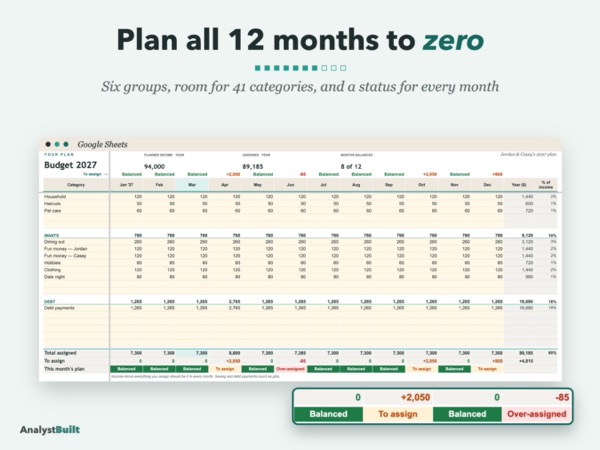
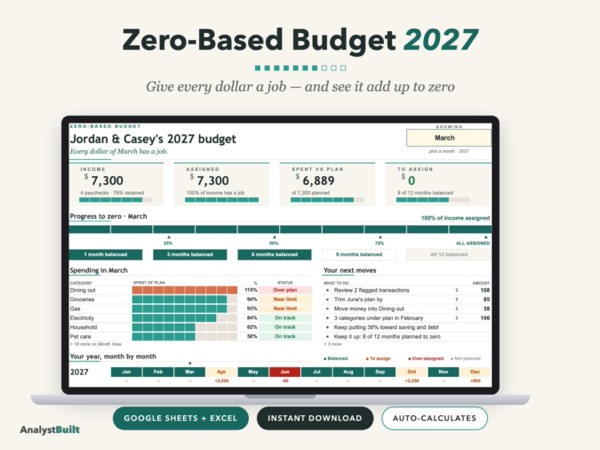
A zero-based budget gives every dollar of the month a place before the month starts. Here is the sample's January plan by group, from the Budget sheet of the Zero-Based Budget:
| January 2027 | Planned |
|---|---|
| Income: two paychecks and a side gig | $7,300 |
| Giving | $200 |
| Saving: emergency fund $520, sinking funds $985 | $1,505 |
| Bills: mortgage, utilities, phone, streaming, insurance, gym | $2,170 |
| Needs: groceries, gas, pharmacy, household, haircuts, pet care | $1,400 |
| Wants: dining out, fun money, hobbies, clothing, date night | $760 |
| Debt payments | $1,265 |
| To assign | $0 |
The check at the bottom is one formula. Income is in C5 and the total of every category is in C62:
=ROUND(C5-C62,2)When it shows 0, the month is Balanced. A positive number means money with no plan yet; a negative one means you planned more than you earn.
Notice where Saving sits: it is planned before Wants, not taken from whatever is left on the 31st. The simplest version of that is a transfer on payday for the $1,505.
Saturday evening: sinking funds for the bills you can see coming
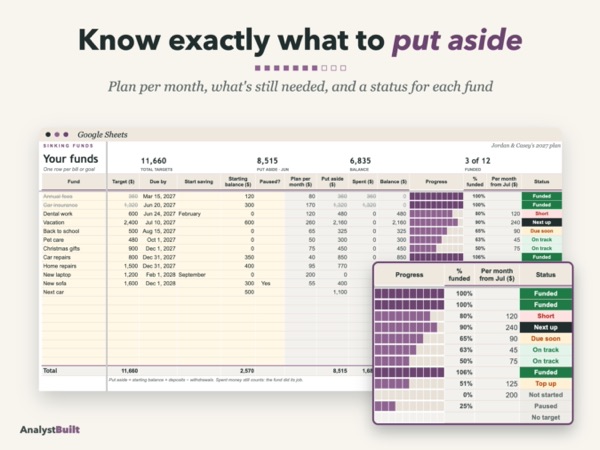
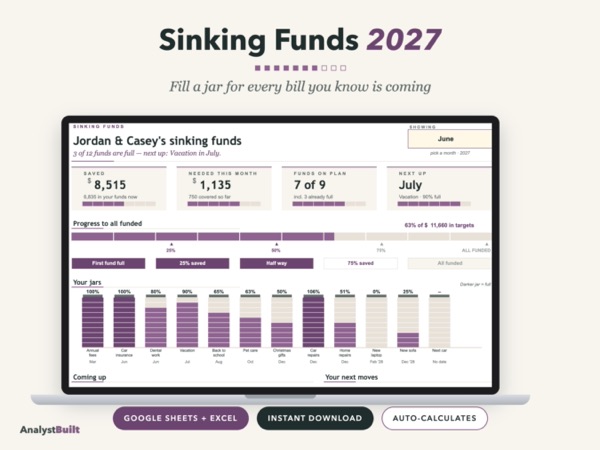
Most of the $985 is not a guess: $835 of it comes from a list of bills and goals with a target and a due date, on the Funds sheet of Sinking Funds. The other $150 goes to the paused sofa fund and a next-car fund with no target, which the Monthly Plan sheet shows as Outside the plan. Five of the sample's twelve funds:
| Fund | Target | Starting balance | Due | Per month |
|---|---|---|---|---|
| Annual fees | $360 | $120 | Mar 15 | $80 |
| Car insurance | $1,320 | $300 | Jun 20 | $170 |
| Vacation | $2,400 | $600 | Jul 10 | $260 |
| Christmas gifts | $900 | $0 | Dec 1 | $75 |
| Home repairs | $1,500 | $400 | Dec 31 | $95 |
Each monthly amount is what is still missing, divided by the months until the due date, rounded up to the next $5. For the vacation fund, $1,800 is missing and there are seven months from January to July:
=CEILING((2400-600)/7, 5)That gives $260 instead of $257.14, so the fund does not fall a few dollars behind. The template does the same for every row, works out the months from the dates and recalculates as deposits come in: in the sample, July needs only $240.
This is also where "save more" turns into something you can measure: a target, a date and an amount per month. The emergency fund gets its own line in the budget too, $520 in the sample's January, so it is planned rather than left to chance. If there is no cushion yet, a small amount every month is still a start.
Sunday morning: every debt on one list
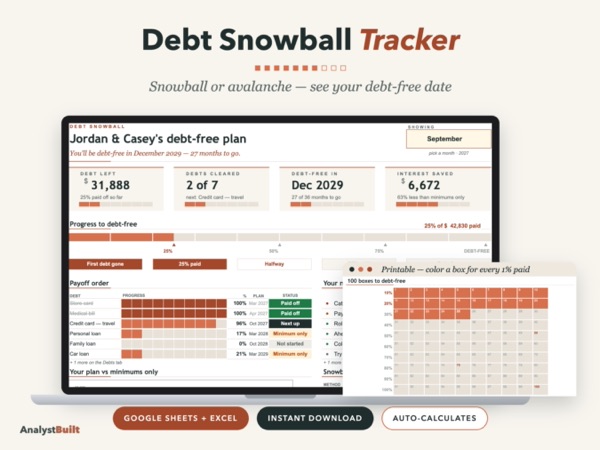
On the Debts sheet of the Debt Snowball & Avalanche tracker, the sample lists seven debts: $42,830 at the start of 2027 with $815 of minimums a month. Jordan & Casey add $450 a month on top, plus their $1,500 tax refund in April. The $815 plus $450 is the $1,265 debt line in the budget, so the two files agree.
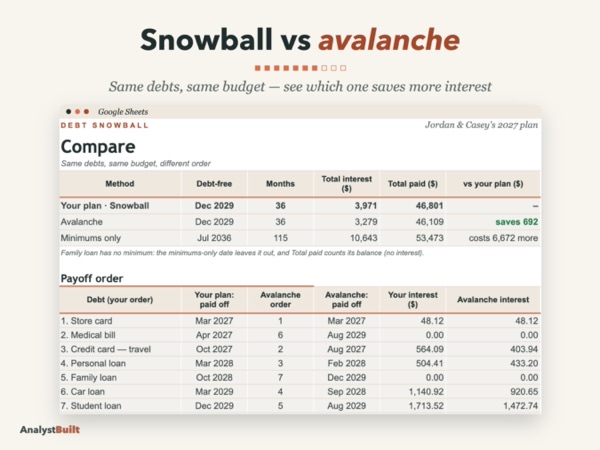
The order decides where the extra goes. Snowball pays the smallest balance first; avalanche pays the highest rate first. The Compare sheet runs the same debts and the same money both ways:
| Plan | Debt-free | Months | Interest |
|---|---|---|---|
| Snowball | Dec 2029 | 36 | $3,971 |
| Avalanche | Dec 2029 | 36 | $3,279 |
| Minimums only | Jul 2036 | 115 | $10,643 |
In this sample both orders finish in the same month and both clear the store card in March; avalanche costs about $692 less interest, while snowball clears the medical bill in April 2027 instead of August 2029. Which one suits you is your call — the sheet shows both so you can see the trade-off on your own numbers.
Add the due day for every debt while you are here. Late fees and extra interest usually come from a missed date, not from the plan.
Sunday afternoon: one net worth number
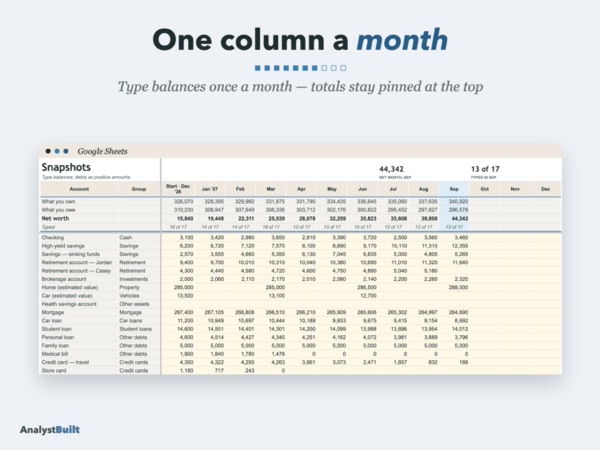
Go back to Saturday's list and split it into what you own and what you owe. In the sample's Net Worth Tracker, the starting column (December 2026) says $326,070 owned and $310,230 owed. Net worth is the difference, $15,840:
=IF(D5="","",D5-D6)D5 is what you own and D6 what you owe; the IF part keeps the cell blank until you fill in that month. One number a month is enough; the trend matters more than any single value. In the sample, the January column reads $19,448. These are invented numbers; the change comes from mortgage payments, debt payments and savings, and yours will move at its own pace.
After the weekend: 15 minutes a week
Pick one day of the week and give the four sheets 15 minutes: log what you spent, mark payments, add deposits to the funds, and read the Next moves list on each Dashboard. Regular beats perfect. A simple system you open every week is worth more than an elaborate one you open in January.
Where this breaks
- Irregular income. A zero-based plan built on money you expect breaks when a payment is late or smaller. Plan on what you are sure of and assign the rest when it arrives. In the sample, April brings Jordan's third paycheck of the month. The $1,500 tax refund already goes to debt, but the extra $2,050 has no plan yet, so the Budget sheet shows $2,050 To assign instead of Balanced.
- Over-assigned months. In June the sample plans $85 more than it earns, and the status turns to Over-assigned. Fix that before the month starts, not after.
- Funds that start late. The dental fund ($600 by June 24) only starts in February, so it needs $120 a month instead of $100. In the sample, May and June get $60 each, so by June it is 80% full and marked Short. A late start leaves less room for a light month.
- Debts with no minimum. The family loan has no minimum, so the "minimums only" line leaves it out. The 115 months cover the other six debts.
- Estimates in net worth. A home or car value is an estimate. Change it rarely and keep it modest, or one new estimate can move the number more than a month of saving.
- A reset with no follow-up. Without the weekly check, the numbers are a month out of date by February.
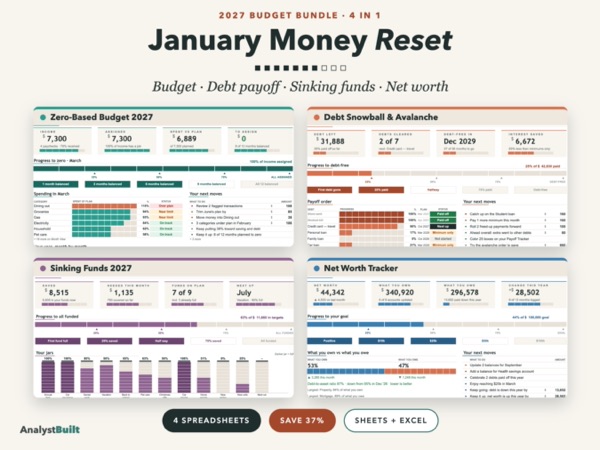
Use it
Google Sheets & Excel templates for this topic, sold and delivered through Etsy.
Personal Finance
Zero-Based Budget 2027
Monthly zero-based budget, paycheck planner, transactions log, month view and year summary
Personal Finance
Debt Snowball & Avalanche Payoff Tracker
Debt-free date, month-by-month payoff plan, snowball vs avalanche, payment log and a printable coloring chart
Personal Finance
Sinking Funds 2027
Savings jars for every bill you know is coming, with a monthly plan and a printable tracker